
A website maintenance proposal template should identify the existing website and CMS, then define updates, backups, monitoring, support, content-edit allowances, reporting, pricing, client dependencies, and exclusions. It can be created in Google Docs or Slides, with an optional Google Sheets budget.
The strongest proposals describe specific actions instead of promising uninterrupted uptime, complete security, guaranteed recovery, or resolution within a fixed period. They also distinguish routine maintenance from remediation, development, hosting, and third-party services.
Editable Word template · free download
Download the website maintenance proposal template
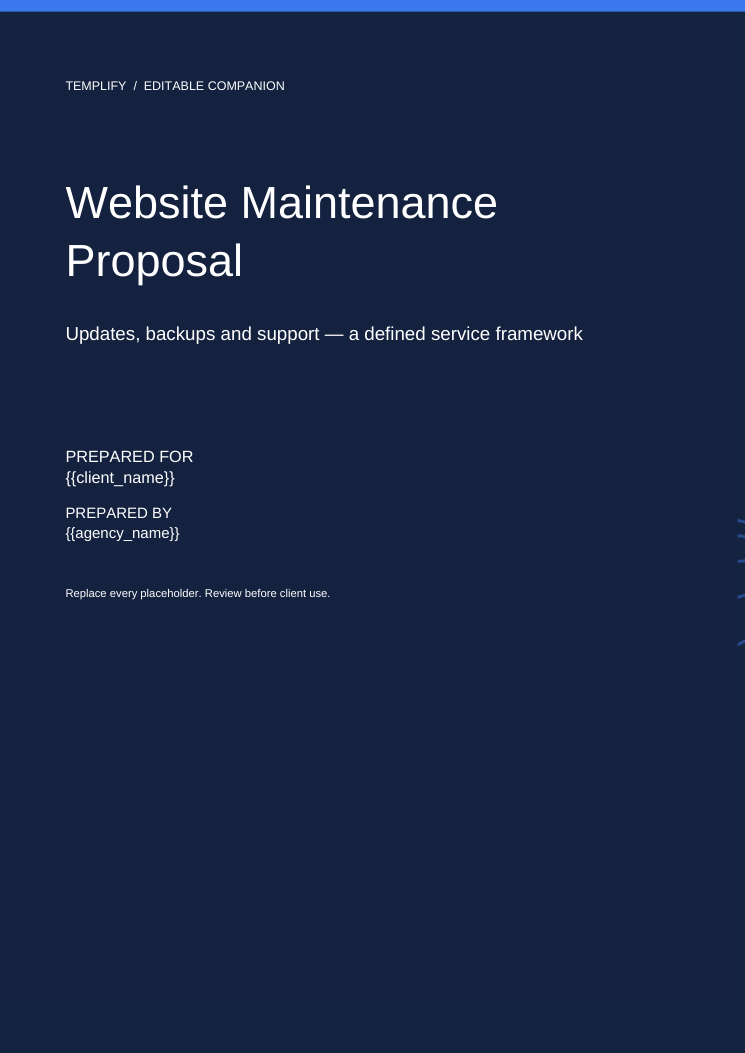
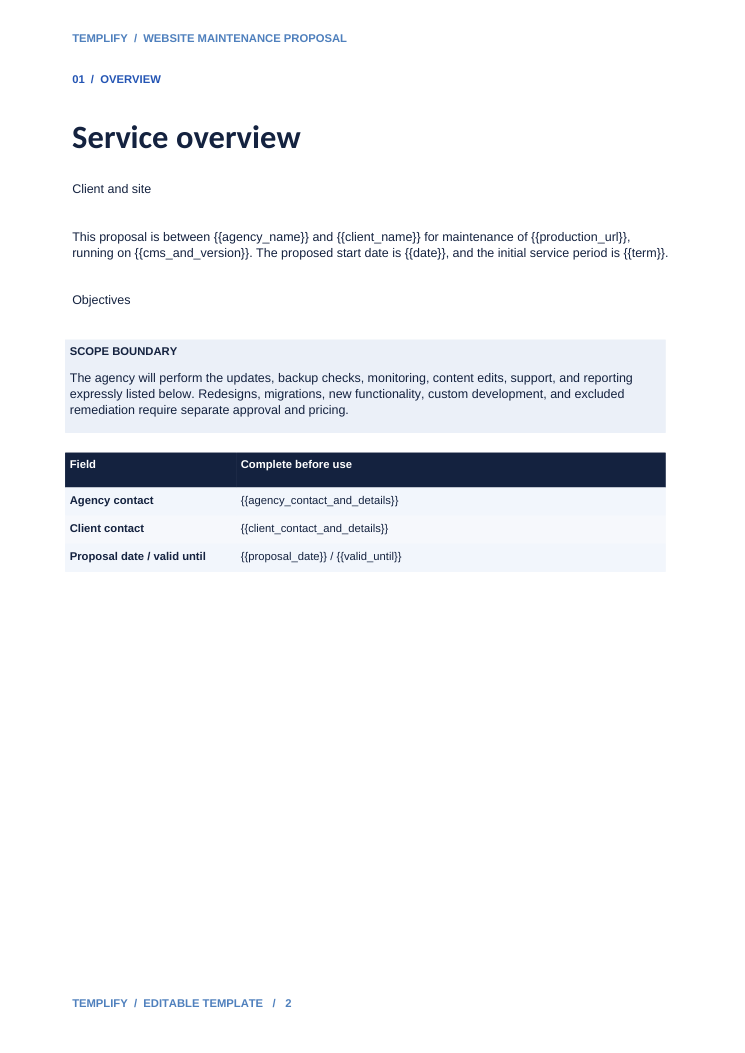
Preview the cover and an actual interior page, then make the proposal your own.
Edit in Word or upload to Google Docs.
Direct download. No email required.
Copyable Website Maintenance Proposal Structure
Use this structure in a Google Doc or Slides presentation:
- Client and agency details
- Proposal summary and maintenance objectives
- Covered website, CMS, domain, and technical inventory
- Update cadence and change procedure
- Backups, restore testing, and rollback
- Uptime monitoring and incident triage
- Content-edit allowance and support process
- Maintenance reports and client responsibilities
- Recurring fees, overages, and third-party costs
- Exclusions, renewal, and cancellation
- Approval and next steps
A separate Sheet can hold recurring charges, optional services, license costs, and approved overages. For detailed deliverables or acceptance criteria, pair the proposal with a Google Docs statement of work. Because a proposal and contract do not necessarily serve the same purpose, review proposal versus contract when deciding which documents the engagement requires.
Consolidated Fill-In Website Maintenance Proposal
Copy the following language and replace every bracketed field:
Client and site: This proposal is between [agency name] and [client name] for maintenance of [production URL], running on [CMS and version]. The proposed start date is [date], and the initial service period is [term].
Objectives: The agency will perform the updates, backup checks, monitoring, content edits, support, and reporting expressly listed below. Redesigns, migrations, new functionality, custom development, and excluded remediation require separate approval and pricing.
Technical inventory: Covered assets are [production URL], [staging URL], [CMS], [theme], [plugins/modules/extensions], [custom code], and [named integrations]. The domain registrar is [provider], DNS is managed by [party/provider], and hosting is owned and managed by [client/agency/third party]. Software licenses are owned and renewed by [responsible party].
Updates and maintenance window: Routine updates will be reviewed [cadence]. Approved production work will normally occur during [day, time, and time zone]. The agency will check available release information, confirm the agreed backup, perform [staging test/compatibility check], deploy approved changes, and check [pages, forms, or functions] afterward.
Backups and restore tests: Backups will cover [files/database/both], be created or confirmed by [responsible party], and be stored through [system or provider] with [retention, if confirmed]. Restore testing will occur [cadence] in [environment] and depends on [required access or third party].
Rollback: Rollback may be initiated when [defined failure criteria] occur after a covered change. Authorization must come from [name or role] through [email/ticket/other record]. If immediate authorization is unavailable, the agency may [pause work/leave the prior version in place/take another agreed action].
Monitoring and support: Monitoring will check [pages or endpoints] every [frequency] and send alerts to [contacts]. Support hours are [hours and time zone]. Requests must be submitted through [channel]. The initial-response target is [period]; any resolution estimate will be provided after triage and is not the same as the response target.
Content allowance: The recurring fee includes [hours/tasks/credits] per month for [eligible edits]. Unused allowance [expires/carries forward], with rollover limited to [amount and expiration]. Overage work is billed at [rate] or quoted separately and requires approval from [role].
Reporting and dependencies: A maintenance report will be delivered [frequency and method]. The client will provide current access, licensed software, content, feedback, and approvals. If approval is not received by [deadline], the affected work will [move to the next window/be re-estimated/be treated as late-approved work].
Fees and payment: The recurring fee is [amount], billed [frequency] and payable [in advance/in arrears] within [number] days. Third-party charges and approved overages are [included/not included]. Late payments are handled as follows: [terms].
Renewal and cancellation: The engagement [renews automatically/ends on date/renews by written agreement]. Either party may cancel with [number] days’ written notice. Final billing, unused allowance, access return, and transition documentation will be handled as follows: [terms].
Approval: Approval by [method] authorizes the agency to begin the included work, subject to any separate contract or statement of work required by the parties.
Proposal Summary and Maintenance Objectives
Frame the engagement as recurring maintenance for one named, existing website rather than an open-ended development arrangement. Include the start date, initial term, billing frequency, and primary contacts. The summary should make the boundary clear: routine maintenance is included only to the extent described, while expanded troubleshooting and project work require separate authorization.
Website, CMS, and Access Inventory
Record production and staging URLs, the CMS and current version, the theme, active extensions, known custom code, connected services, and responsible vendors. Identify the owner of the domain, hosting account, backups, and paid licenses.
Work should depend on the client supplying current credentials or approved account access. Newly discovered, unlicensed, obsolete, or unsupported components should be assessed before work proceeds; their remediation or replacement is not automatically included.
Update Cadence and Change Procedure
For routine, priority, and emergency updates, specify the review cadence, compatibility check, approval requirements, deployment responsibility, and maintenance window. A maintenance window is the scheduled period when approved work may occur. It is not an initial-response target or a resolution estimate.
A practical agency scenario might proceed as follows: a routine plugin update appears during the weekly review. The agency confirms the pre-change backup and tests the update on staging. The compatibility check fails because a custom form no longer submits correctly, so the agency does not deploy the update to production. It documents the conflict, restores or retains the known working staging state, and sends the client a separately priced remediation estimate. After approval, remediation can be scheduled independently of the recurring maintenance allowance.
Major version upgrades, unsupported software, conflict remediation, and custom development should follow the same separate-approval process when they exceed routine maintenance.
Backups, Restore Testing, and Rollback
State whether backups include files, the database, or both, along with storage, retention, access dependencies, and responsibility. Define the restore-testing cadence and environment. Before covered production changes, create or confirm the agreed backup. Name the person or role authorized to approve rollback and record that decision through the agreed channel. Backup availability and testing reduce risk but do not guarantee complete or immediate recovery.
Uptime Monitoring and Incident Triage
List the monitored pages or endpoints, check frequency, support hours, alert recipients, and escalation contacts. Triage should cover alert confirmation, initial review, likely-cause classification, notification, and referral to the host, domain provider, developer, or specialist when necessary.
Use a small service-target table to prevent different time concepts from being conflated:
| Service target | Copyable value | Meaning |
|---|---|---|
| Initial response | [For example: four support hours] |
Target for acknowledging and beginning review of a qualifying request or alert |
| Maintenance window | [Day, time, and time zone] |
Scheduled period for approved maintenance work |
| Resolution estimate | [Provided after triage] |
Case-specific estimate based on the diagnosed issue, dependencies, and approvals |
Monitoring observes availability but does not guarantee uptime. An initial-response target is not a promise that restoration or resolution will occur within the same period.
Content Edits, Support, and Overage Handling
Express the monthly allowance in hours, tasks, or request credits. Eligible work might include replacing client-supplied text, swapping an existing image, changing contact details, or updating an existing link. State whether unused allowance expires or carries forward, including any rollover cap and expiration.
Identify the request channel, required information, urgency rules, authorized approvers, overage rate, and separate-quote process. New pages, troubleshooting, remediation, integrations, and new functionality remain outside the allowance unless expressly included.
Maintenance Reports and Client Responsibilities
Reports can summarize updates completed, checks performed, incidents reviewed, allowance used, outstanding risks, and approvals needed. Name client responsibilities for access, licenses, content, feedback, and timely decisions. If an approval misses its deadline, say whether work moves to the next maintenance window, requires a new schedule, or may incur an approved fee.
Website Maintenance Pricing Proposal
A practical Google Sheets budget should separate recurring fees, allowances, overages, and external charges:
| Service | Quantity or allowance | Recurring fee | Overage rate | Third-party cost | Billing frequency | Approval status |
|---|---|---|---|---|---|---|
| Routine maintenance | [Included updates/checks] |
[Amount] |
[Rate or N/A] |
[Amount or none] |
[Monthly/quarterly] |
[Approved/pending] |
| Content edits | [Hours/tasks] |
[Included/amount] |
[Rate] |
[Amount or none] |
[Frequency] |
[Status] |
| Monitoring | [Endpoints/checks] |
[Amount] |
[Rate or N/A] |
[Provider charge] |
[Frequency] |
[Status] |
| Hosting and licenses | [Items] |
[Amount or excluded] |
[N/A] |
[Estimated charge] |
[Frequency] |
[Status] |
| Remediation | [Separate scope] |
[Not included] |
[Rate/quote] |
[If applicable] |
[Per approval] |
[Pending] |
State payment timing, the owner of hosting and software licenses, and how third-party price changes are handled. For a variable-cost workflow, see how to prepare proposals from Google Sheets.
Exclusions, Renewal, and Cancellation
Common exclusions include new builds, redesigns, migrations, ecommerce builds, feature development, employee help desk support, device or network management, general IT administration, and enterprise backup services. Broader infrastructure support belongs in a separate IT services proposal.
Specify the initial term, renewal method, cancellation notice period, final billing, treatment of unused allowance, and return of access. If enforceable service-level or contractual language is required, obtain appropriate professional review rather than treating this maintenance template as legal SLA drafting.
Final Review Checklist Before Sending
- Confirm the website, CMS, environments, inventory, access, and license ownership.
- Reconcile update cadence, maintenance windows, backups, restore tests, rollback authority, and approvals.
- Verify response targets, monitoring limits, allowance rollover, overages, payment timing, renewal, and cancellation.
- Confirm that the proposal describes actions without guaranteeing uptime, security, recovery, or resolution.
- Obtain human approval before publishing the client version.
Reuse, Publish, and Track the Proposal in Google Workspace
Keep the approved structure in an existing Google Doc or Slides file and use Sheets for the budget. For each client, duplicate the approved source, populate the client-specific inventory and commercial fields, review every placeholder, and publish the client link. Monitor available view signals, then have the responsible team member conduct manual follow-up. See these agency proposal templates for Google Workspace for document-organization examples.
Templify uses existing Google Docs, Slides, and Sheets as proposal sources, publishes client proposal links, and tracks proposal views and engagement. Those view signals can inform manual follow-up timing while the team retains control of review and outreach.
Editable Word template · free download
Download the website maintenance proposal template
Preview the cover and an actual interior page, then make the proposal your own.
Edit in Word or upload to Google Docs.
Direct download. No email required.