
A graphic design proposal should define each collateral asset, distinguish concepts from adaptations, document production specifications, limit revision rounds, assign approval authority, and state which final and editable files will be handed over. This template covers production work using an approved brand system rather than brand strategy, identity creation, copywriting, website work, or print procurement.
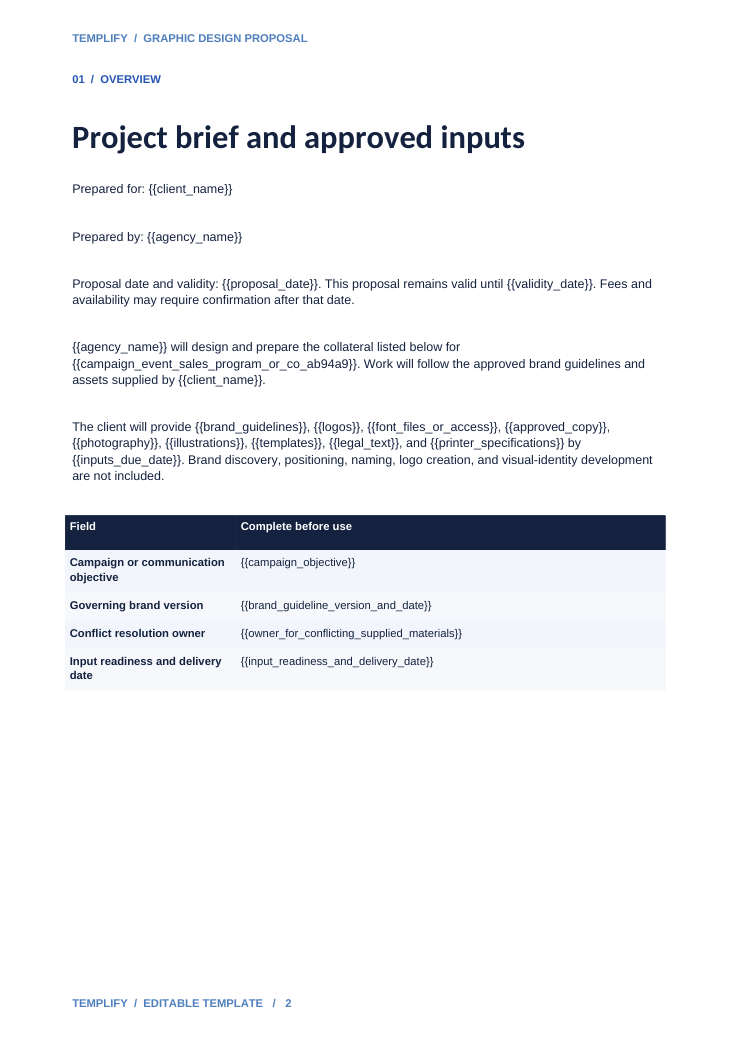
Editable Word template · free download
Download the graphic design proposal template
Preview the cover and an actual interior page, then make the proposal your own.
Edit in Word or upload to Google Docs.
Direct download. No email required.
How to use this graphic design proposal template
Copy the complete template below into Google Docs or Google Slides. Replace every bracketed placeholder, delete inapplicable options, and attach the asset matrix, budget, or handover schedule as additional pages when necessary. For projects with many versions or costs, maintain those schedules in Google Sheets and link them from the proposal.
A proposal describes proposed work and commercial terms but doesn’t automatically replace the final agreement. For more formal responsibilities and milestones, use this Google Docs statement of work template and review the difference between a proposal and a contract.
Copyable proposal template
COPY FROM HERE
Graphic Design Proposal
Prepared for: [Client legal name]
Prepared by: [Agency legal name]
Proposal date and validity: [Date]. This proposal remains valid until [date]. Fees and availability may require confirmation after that date.
Project objective
[Agency] will design and prepare the collateral listed below for [campaign, event, sales program, or communication objective]. Work will follow the approved brand guidelines and assets supplied by [client].
Approved inputs
The client will provide [brand guidelines], [logos], [font files or access], [approved copy], [photography], [illustrations], [templates], [legal text], and [printer specifications] by [date]. Brand discovery, positioning, naming, logo creation, and visual-identity development are not included.
Deliverables
| Asset | Size/pages | Concepts | Adaptations or versions | Final formats | Due date |
|---|---|---|---|---|---|
| [Product brochure] | [8 pages, US Letter] | [2] | [1 approved version] | [Print PDF, web PDF, source] | [Date] |
| [Event poster] | [24 × 36 in] | [1] | [11 × 17 in adaptation] | [Print PDF, JPG] | [Date] |
| [Paid social graphic] | [1080 × 1080 px] | [Uses approved poster direction] | [3 copy versions] | [PNG] | [Date] |
An original concept is a distinct visual direction. An adaptation applies an approved concept to another listed placement. Resizing reformats approved artwork without changing its core direction. Version production changes specified variables such as language, region, image, offer, or legal copy.
Production specifications
Print files will be supplied as [PDF standard or printer-requested format], at [resolution], using [color profile], with [bleed]. Digital files will use the dimensions, color mode, transparency requirements, file-size limits, and formats listed in the asset matrix. The client will approve dimensions, content, colors, proofs, quantities, and release to production.
Licensed assets
The client will supply or purchase [fonts, stock images, illustrations, icons, or templates]. Any new chargeable asset requires written approval before purchase. Editable-file delivery does not transfer third-party materials beyond their applicable license terms.
Revisions and additional work
The fee includes [number] concept revision rounds and [number] production revision rounds. One round means one consolidated feedback set from the authorized client contact. Feedback is due within [number] business days. Changes to approved concepts, copy, dimensions, quantities, formats, or specifications are additional work billed at [rate] after written approval.
Schedule and approval authority
Work begins after [deposit/payment], receipt of required inputs, and confirmation to proceed. [Name and role] is authorized to consolidate feedback, approve milestones, and accept deliverables for the client. Feedback or inputs received after a stated deadline will shift dependent dates by at least the corresponding delay. Longer delays may require rescheduling according to agency availability.
Fees and payment
The project fee is [amount], excluding [applicable taxes and approved third-party costs]. A [percentage]% deposit is invoiced upon acceptance, [percentage]% at [concept approval], and [percentage]% before final-file delivery. Invoices are due within [14] calendar days. Approved additional work is invoiced [weekly, monthly, or with the next milestone].
If the client cancels the project, the client will pay for work completed through the cancellation date plus approved, non-cancellable third-party commitments. The deposit will be applied to those amounts. Any further cancellation fee must be stated here: [fee or not applicable].
Handover and acceptance
Final delivery will include only the formats, source files, linked assets, and supporting information listed in the handover schedule. The client will report missing, unreadable, or technically defective files within [five] business days. Corrections required to match the approved proof and specifications are not new revisions; later content edits, new versions, or design changes are additional work.
Change control and exclusions
Any additional asset, page, size, language, audience version, format, quantity, or editable file not listed in the approved scope requires a written fee and schedule adjustment. Exclusions include brand strategy, identity creation, website work, copywriting, translation, print buying, vendor management, manufacturing, fulfillment, shipping, and installation unless expressly added.
Acceptance
Accepted for [client] by [authorized name, title, method, and date].
END COPY
Proposal summary and approved brand inputs
Confirm that the supplied brand system is genuinely ready for production. An outdated logo folder, unavailable font, unfinished copy, or unapproved printer dieline can stop work even when the proposal has been accepted. Record the version or date of the governing brand guidelines and identify who resolves conflicts between supplied materials.
If the client needs discovery, positioning, or identity work, scope it separately with a brand proposal template. Avoid quietly absorbing strategy into a production engagement because stakeholders disagree about the existing visual direction.
Create the graphic design asset matrix
Use one row per distinct deliverable and make quantities testable. A brochure and its compressed web PDF may be one asset with two outputs, while regional brochures with different copy can require separate versions.
Useful columns include asset, pages, dimensions, orientation, channel, concept allowance, adaptation count, version count, final format, content status, owner, due date, color profile, and acceptance status. If a row says “all required formats,” it is not sufficiently defined.
Separate concepts, adaptations, resizing, and versions
Price these categories separately when they require different effort. Applying an approved poster direction to a half-page advertisement is an adaptation; producing five advertisements with regional disclaimers is version production. Replacing the hierarchy, layout logic, and creative direction after concept approval is usually a new concept, not a routine revision.
A frequent scope problem occurs when a “resize” has a radically different aspect ratio. A square design may not translate to a narrow banner without recomposition. Identify those cases as adaptations before estimating them.
Document print and digital production specifications
For print assets, record finished size, bleed, trim, safe area, folds, binding, dielines, printer template, color profile, resolution, export standard, and font treatment. Clarify whether the scope includes one digital proof, corrected proofs, or printer-requested file adjustments.
For digital assets, document pixel dimensions, file-size limits, transparency, color mode, and output formats such as PNG, JPG, SVG, or web PDF. Unless priced, exclude vendor contracting, physical proofs, manufacturing, shipping, and installation. A printer’s late specification change should be handled through change control rather than treated as an invisible production task.
Define fonts, stock images, and other licensed assets
List who selects, approves, purchases, and holds each license. Keep client-owned materials separate from third-party assets that cannot be transferred or redistributed. When asset research is included, set an allowance for the number of options or time spent; otherwise, an open-ended image search can consume time intended for design.
Set the graphic design revision policy
Revision rounds should be tied to consolidated feedback from one authorized contact. Comments arriving separately from marketing, legal, and leadership can conflict or unintentionally consume multiple rounds.
Distinguish corrections from changes. Fixing a file that fails to match the approved scope is a correction. Replacing approved copy, adding a language, changing dimensions, or reopening an approved concept is additional work. State the rate and require written authorization before proceeding.
Timeline, pricing, and client dependencies
Build the schedule around both production time and client response time. Typical dependencies include final copy, approved imagery, brand files, printer templates, legal review, and stakeholder availability. Do not promise an unchanged final date when a late approval removes the time reserved for the next phase.
For a copyable Google Sheets budget, paste the tab-separated example below into cell A1 and replace the sample quantities and rates:
Line item	Quantity	Unit rate	Amount	Invoice milestone or note
Original concepts	2	750	1500	Deposit/start
Approved-concept adaptations	3	250	750	Concept approval
Regional or copy versions	5	90	450	Production milestone
Third-party licenses	1	300	300	Reimbursable after written approval
Additional work rate	1 hour	150	150	Only when authorized
Subtotal			3150	Before tax
Taxes	1	[applicable rate]	[calculated amount]	Shown separately
Deposit invoice	40%		[40% of total]	Due within 14 calendar days
Concept-approval invoice	30%		[30% of total]	Due within 14 calendar days
Final-delivery invoice	30%		[30% of total]	Due before final-file delivery
The percentages and tax treatment are examples, not universal terms. Confirm the arrangement appropriate to the engagement. For a broader workflow, see Google Sheets in a proposal workflow.
Final deliverables and editable-source-file handover
Use a handover register rather than relying on a folder link alone:
| Check | Record for each deliverable |
|---|---|
| Filename | Exact final filename and version number |
| Application | Creating application and relevant version |
| Source files | Included, excluded, packaged, or flattened |
| Linked assets | Included links and any non-transferable items |
| Fonts and licenses | Font names, access requirements, and license holder |
| Color profile | CMYK, RGB, spot-color, or specified profile |
| Dimensions | Finished size, bleed, orientation, or pixels |
| Acceptance status | Approved, pending, superseded, or rejected |
| Defect deadline | Date for reporting missing, unreadable, or defective files |
A practical folder structure is 01_Print_Ready, 02_Digital_Exports, 03_Editable_Source, 04_Linked_Assets, 05_Font_Information, and 06_Approved_Proofs. Open packaged files on a separate machine or from a clean location before delivery; this can reveal missing links that remain available on the designer’s workstation but not in the package.
Explicit exclusions and change control
Name exclusions instead of relying on assumptions. Common examples are strategy, naming, identity creation, websites, copywriting, translation, print procurement, manufacturing, shipping, and unlisted formats or source files. Before additional work begins, document the requested change, fee, schedule effect, and approving contact.
Publish and track the completed proposal with Templify
An agency can use an existing Google Doc, Slides deck, or Sheet as the proposal source, publish it as a client-ready link, and review proposal views and engagement. Those signals can inform manual follow-up timing. Signing, payment collection, CRM activity, client portals, and automated follow-up remain separate workflows.
Templify creates, publishes, and tracks client proposals from Google Docs, Slides, and Sheets.
Frequently asked questions
What should a graphic design proposal template include?
Include a defined asset matrix, production specifications, concepts and adaptations, revision limits, pricing, approval authority, dependencies, handover requirements, exclusions, and change control.
How do you separate concepts from adaptations and resizing?
A concept is an original direction. An adaptation applies that direction to another placement, while resizing preserves the core design in a new size. Version production changes predefined variables such as language or offer.
How many revision rounds should a proposal allow?
There is no universal number. Set an explicit allowance, define a round as consolidated feedback, and state how extra or fragmented feedback affects fees and dates.
Should editable source files and licensed assets be included?
Only when listed. Identify source applications and packaged assets, while recognizing that fonts, stock imagery, and other third-party materials remain subject to their licenses.
What should be excluded from a production graphic design proposal?
Typical exclusions include strategy, identity creation, websites, copywriting, translation, print procurement, manufacturing, shipping, and any unlisted asset, size, version, format, quantity, or editable file.
Editable Word template · free download
Download the graphic design proposal template
Preview the cover and an actual interior page, then make the proposal your own.
Edit in Word or upload to Google Docs.
Direct download. No email required.