
Short answer: A public relations proposal should define the earned-media objective, target audiences, media scope, pitch angles, outreach limits, deliverables, approvals, timeline, reporting, fees, assumptions, and exclusions. It should distinguish agency-controlled work from journalist responses, coverage, backlinks, and business outcomes that cannot be guaranteed.
The copy-ready template below can be pasted into Google Docs or adapted into Google Slides. It includes practical language for approvals, revisions, postponed interviews, monitoring boundaries, scope changes, and editorial independence.
Editable Word template · free download
Get the editable PR proposal template
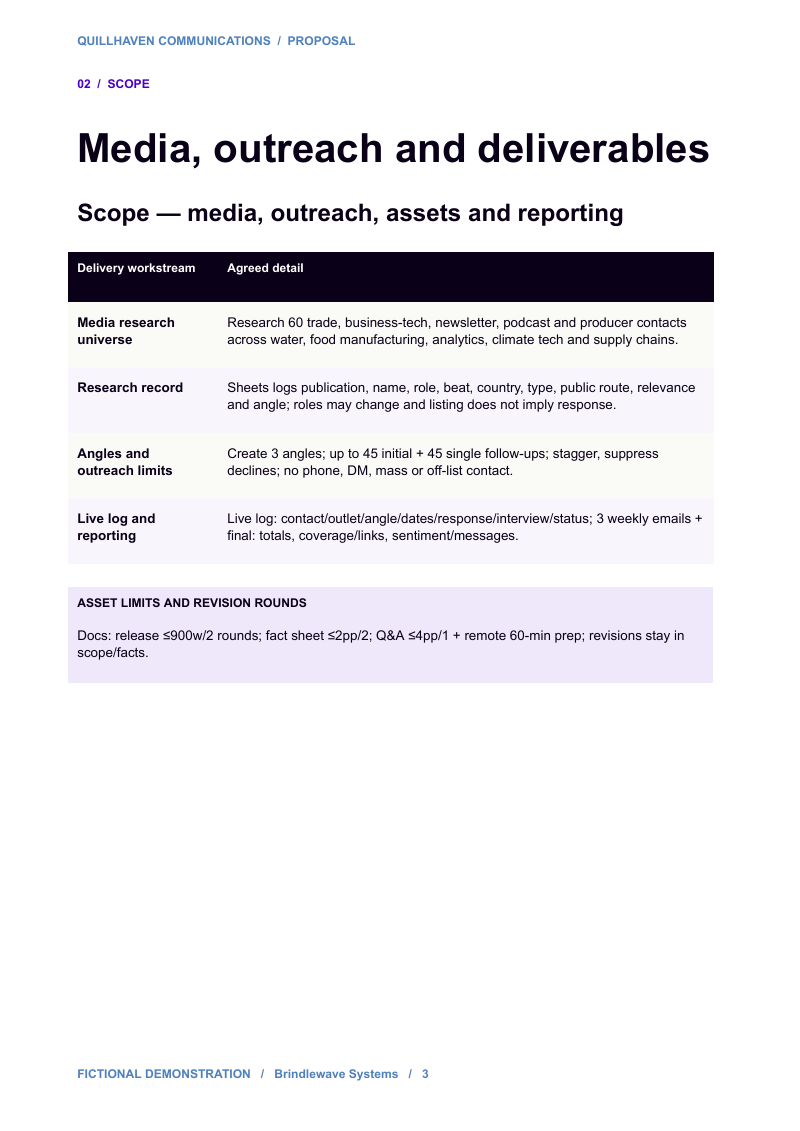
Preview the cover and an actual interior page, then make the proposal your own.
Edit in Word or upload to Google Docs.
Direct download. No email required.
Engagement Summary and Public Relations Objectives
Start with the business context: the announcement, issue, event, launch, executive perspective, or reputation matter behind the engagement. Identify the client, relevant dates, target audiences, markets, available evidence, campaign period, and specific communications objective.
For example: “The engagement will support the US launch of the client’s new software product by developing approved press materials and conducting direct outreach to selected technology and small-business journalists.”
Rank multiple objectives rather than combining them into a general promise to increase awareness. A product launch, thought-leadership program, and reputation initiative may require different messages, media lists, timelines, and fees.
Media and Beat List Scope
Define whether the agency will create a list, refine a client-supplied list, or combine both. State the included editorial beats, countries, languages, outlet types, and contact quantity or selection criteria.
A practical scope might cover up to 60 US-based journalists reporting on workplace technology and small-business software. Inactive, duplicate, or unsuitable contacts should be removed and, where practical, replaced with contacts meeting the same criteria. The contact count measures research and list development, not replies or stories.
Pitch Angles, Outreach Quantities, and Follow-Up Limits
Convert “media outreach” into countable activities. A defined scope could include three researched angles, one approved core pitch per angle, personalization for priority contacts, initial outreach to 40 approved contacts, and no more than two follow-ups per contact.
Clarify whether contacts receive a common pitch, a segment-specific version, or individual personalization. Follow-up should stop after a decline, the agreed attempt limit, or an out-of-office period extending beyond the campaign.
Press Materials and Spokesperson Support
List each asset separately with its quantity, format, delivery method, and revision allowance. Deliverables might include one press release, one digital press kit, a fact sheet, an executive biography, interview talking points, anticipated questions, and two briefing sessions.
If distribution means direct outreach, say so; do not imply that a paid wire service or paid placement is included. The agency may coordinate interviews, but the client remains responsible for spokesperson availability and preparation.
Suggested wording: “The base fee includes two consolidated revision rounds. A new announcement, audience, asset, or campaign direction will be treated as a scope change.”
Client Fact-Checking, Legal Approval, and Sign-Off
Assign the client responsibility for verifying names, dates, quotations, statistics, product claims, permissions, trademarks, and confidential information. Identify the authorized approver and any legal, regulatory, or compliance review.
Use a written approval rule: “No pitch or press material will be released until the client’s authorized reviewer provides written approval. Feedback is due within two business days. Late approval may shift outreach, monitoring, and reporting dates without reducing the agreed fee.”
Agency editing does not replace factual or legal review. The client should confirm that substantiation and permissions are available before approval.
Outreach Logs, Coverage Monitoring, and Earned-Media Reports
Define the records the client will receive. A compact outreach log can use this structure:
| Outlet | Contact | Beat | Pitch version | Initial outreach | Follow-ups | Response status | Interview request | Next action |
|---|---|---|---|---|---|---|---|---|
| [Outlet] | [Name/email] | [Beat] | [A/B/C] | [Date] | [Dates] | [No reply/Interested/Declined] | [Yes/No] | [Action/date] |
Specify monitoring keywords, named publications, markets, languages, and dates. Categorize results consistently as confirmed coverage, pending opportunity, declined pitch, or no response.
Suggested boundary: “Monitoring covers publicly accessible online coverage matching the approved keywords during the stated period. It does not include comprehensive broadcast, print, paywalled, social, or historical monitoring unless separately listed.”
Reports can summarize completed outreach, confirmed coverage, open opportunities, journalist feedback, and next steps. Traffic or inquiries may be included when reliable client data is available, without claiming unsupported attribution.
Outputs, Media Decisions, and Business Outcomes
| Category | Examples | Agency control |
|---|---|---|
| Agency outputs | Research, drafting, pitching, follow-up, briefing, monitoring, reporting | Controlled within scope and client dependencies |
| Editorial decisions | Replies, interviews, publication date, headline, edits, prominence, tone, links | Controlled by journalists or publishers |
| Business outcomes | Reach, traffic, leads, sales, search performance, reputation change | Influenced by multiple factors |
Use explicit wording: “The agency does not guarantee journalist responses, interviews, placement, favorable coverage, publication timing, backlinks, traffic, leads, or sales. Editorial decisions remain independent.”
Timeline, Dependencies, and Working Assumptions
Use actual dates once reviewer and spokesperson availability are confirmed. A realistic phased schedule could be:
| Phase | Example duration | Dependency |
|---|---|---|
| Discovery and source review | Days 1–3 | Client materials and kickoff access |
| Media research and angle development | Days 4–7 | Confirmed audiences and claims |
| Drafting press materials | Days 8–11 | Complete source information |
| Client review and approval | Days 12–14 | Consolidated written feedback |
| Initial outreach | Days 15–18 | Final written approval |
| Follow-up and interview coordination | Days 19–28 | Journalist and spokesperson availability |
| Monitoring and final reporting | Days 29–35 | Defined keywords and data access |
Suggested wording: “If an interview is postponed, the agency will make reasonable efforts to reschedule it within the active campaign period. Coordination outside that period may require a revised timeline or fee.”
Changed facts, missed approvals, paused announcements, or unavailable spokespeople may shift delivery dates. A separate statement of work can document responsibilities and acceptance conditions. A proposal is an offer rather than automatically the final agreement; see this proposal-versus-contract guide.
Fees, Optional Services, and Exclusions
Connect fees to quantities, time periods, revision limits, expenses, and payment terms. A Google Sheets budget can use these columns:
| Service | Quantity | Unit or project fee | Expenses | Optional status | Subtotal |
|---|---|---|---|---|---|
| Media research | 60 contacts | [Fee] | [Expense] | Included | =Quantity×Fee+Expenses |
| Pitch development | 3 angles | [Fee] | 0 | Included | [Subtotal] |
| Media outreach | 40 contacts | [Fee] | 0 | Included | [Subtotal] |
| Press materials | 2 assets | [Fee] | 0 | Included | [Subtotal] |
| Spokesperson briefing | 2 sessions | [Fee] | 0 | Optional | [Subtotal] |
| Coverage monitoring | 1 period | [Fee] | [Expense] | Included | [Subtotal] |
| Final reporting | 1 report | [Fee] | 0 | Included | [Subtotal] |
| Total | =SUM(F2:F8) |
Replace text quantities with numeric values in a working sheet or calculate project-fee rows directly. Distinguish included and optional rows, and require written expense approval.
Exclude paid advertising, paid placement, wire fees, media buying, social publishing, community management, brand identity work, ongoing article production, crisis response, and guaranteed coverage unless separately scoped. Use: “Out-of-scope work requires a written estimate and client approval before work begins.”
Copy-Ready Public Relations Proposal Template
Client: [Client name]
Campaign: [Campaign or announcement]
Proposal date: [Date]
Engagement period: [Start date–end date]
Context and Objectives
[Agency name] will support [campaign context] for [client name]. The objective is to [specific communications objective] among [target audiences] in [markets]. Available evidence and source materials include [research, approved claims, data, quotations, or other materials].
Media Scope
The agency will [create/refine] a media list covering [beats, outlet types, regions, and languages]. Contacts will be selected using these criteria: [relevance, recent coverage, audience, geography, and role]. The list will include up to [quantity] contacts. Inactive, duplicate, or unsuitable contacts will be removed and, where practical, replaced.
Angles and Outreach
The agency will develop [quantity] pitch angles concerning [topics]. Following approval, it will send [core/segment-specific/personalized] pitches to up to [quantity] approved contacts. Follow-up is limited to [quantity] attempts per contact and stops after [decline, deadline, or other condition].
Press Materials and Spokesperson Support
Included materials: [press release], [media advisory], [fact sheet], [biography], [press kit], and [other assets]. Included support: [quantity] briefing sessions, [talking points], [anticipated questions], and coordination of up to [quantity] interview opportunities. The fee includes [quantity] consolidated revision rounds.
Approvals and Changes
The client will verify facts, claims, quotations, permissions, and confidential information. [Approver name/role] will provide written approval by [deadline]. Late approval may shift campaign dates. New audiences, announcements, deliverables, or material direction changes require a written scope and fee adjustment.
Timeline and Reporting
Discovery: [dates]. Drafting: [dates]. Approval: [dates]. Outreach: [dates]. Follow-up: [dates]. Monitoring: [dates]. Final report: [date]. Reporting will include [frequency], [outreach log], [coverage summary], [open opportunities], and [recommended next steps].
Fees, Assumptions, and Exclusions
Base fee: [currency and amount]. Billing schedule: [schedule]. Approved expenses: [terms]. Optional services: [services and fees]. Assumptions: [client access, reviewer availability, spokesperson availability, and source-material readiness]. Exclusions: [paid media, wire distribution, social publishing, crisis response, or other exclusions]. Editorial outcomes, backlinks, traffic, leads, and sales are not guaranteed.
How to Use the Template in Google Docs, Slides, and Sheets
Copy this template into Google Workspace: select the copy-ready block, paste it into a new Google Doc, and replace every bracketed field. For Slides, use one section per slide. Put the budget and outreach log into Sheets, then confirm that names, dates, quantities, currency, and totals match across files.
Keep a clean master and duplicate it for each prospect. These Google Workspace agency proposal examples offer related structural guidance, while this guide explains creating proposals from Google Sheets.
Publishing and Tracking the Proposal
Templify uses existing Google Docs, Slides, and Sheets as proposal sources, publishes client-ready proposal links, and tracks proposal views and engagement. Those view signals can inform manual follow-up timing within a reusable agency workflow. For the follow-up itself, use a manual process such as the examples in this proposal follow-up guide.
Frequently Asked Questions
What sections should a public relations proposal template include?
Include objectives, audiences, media criteria, angles, outreach quantities, materials, spokesperson support, approvals, timeline, reporting, fees, assumptions, options, and exclusions.
How many media contacts and follow-ups should a PR proposal specify?
Set a realistic quantity based on the relevant media pool and required personalization. State a maximum follow-up count and stop after a decline or the agreed limit.
Who is responsible for fact-checking and legal approval?
The client should verify its facts, claims, quotations, permissions, and confidential information and obtain required legal or compliance review. Outreach should require written approval.
How should a PR proposal measure earned-media work without guaranteeing coverage?
Measure list development, approved materials, pitches, follow-ups, briefings, monitoring, and reports. Record responses and coverage as observed results rather than promised deliverables.
What services should be excluded from a media relations proposal?
Unless separately approved, exclude paid media, paid placement, social publishing, identity work, ongoing editorial production, crisis response, and guarantees of coverage, backlinks, or business outcomes.
Editable companion template
Editable Word template · free download
Get the editable PR proposal template
Preview the cover and an actual interior page, then make the proposal your own.
Edit in Word or upload to Google Docs.
Direct download. No email required.
The template contains fictional worked-example values. Review and replace the example identities, scope, prices and dates before use.