
Short answer: Use this ecommerce web design proposal template to define catalog migration, storefront deliverables, cart and checkout behavior, shipping and tax responsibilities, pricing, launch dependencies, change control, and acceptance in a Google Doc.
Unlike a general website proposal, an ecommerce proposal must account for structured product data, transactional paths, provider accounts, operational rules, and launch sequencing. The copyable proposal below can be adapted for a new store, redesign, replatform, or migration.
Editable Word template · free download
Download the ecommerce web design proposal template
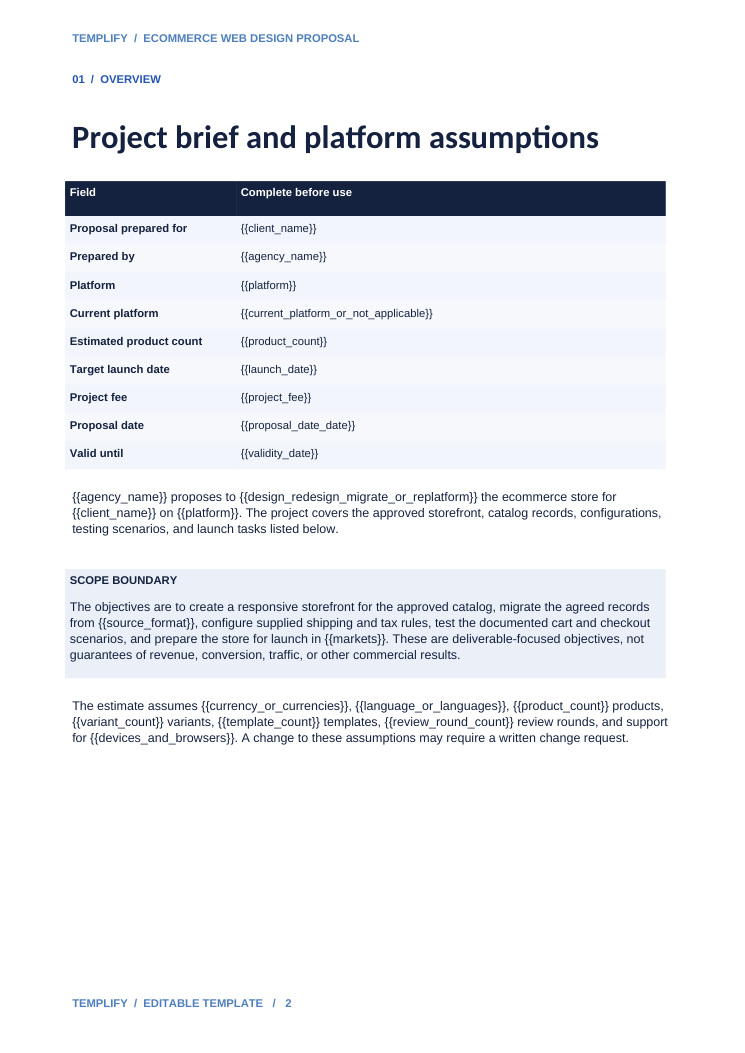
Preview the cover and an actual interior page, then make the proposal your own.
Edit in Word or upload to Google Docs.
Direct download. No email required.
Ecommerce Web Design Proposal Structure
Copy the following proposal from beginning to end, replace each bracketed placeholder, and remove rows that do not apply. If the approved requirements need a separate delivery document, transfer them into a statement of work template for Google Docs.
Proposal prepared for: [Client Name]
Prepared by: [Agency Name]
Platform: [Platform]
Current platform: [Current Platform or Not Applicable]
Estimated product count: [Product Count]
Target launch date: [Launch Date]
Project fee: [Project Fee]
Proposal date: [Date]
Valid until: [Validity Date]
Project Summary, Objectives, and Platform Assumptions
[Agency Name] proposes to [design, redesign, migrate, or replatform] the ecommerce store for [Client Name] on [Platform]. The project covers the approved storefront, catalog records, configurations, testing scenarios, and launch tasks listed below.
The objectives are to create a responsive storefront for the approved catalog, migrate the agreed records from [Source Format], configure supplied shipping and tax rules, test the documented cart and checkout scenarios, and prepare the store for launch in [Markets]. These are deliverable-focused objectives, not guarantees of revenue, conversion, traffic, or other commercial results.
The estimate assumes [Currency or Currencies], [Language or Languages], [Product Count] products, [Variant Count] variants, [Template Count] templates, [Review Round Count] review rounds, and support for [Devices and Browsers]. A change to these assumptions may require a written change request.
Storefront Design and Ecommerce Deliverables
| Deliverable | Included scope | Review or acceptance |
|---|---|---|
| Discovery | [Workshop Count] workshops and requirements summary | Written approval within [Days] business days |
| Design | [Pages or Templates], [Directions] design direction(s) | [Rounds] consolidated review rounds |
| Storefront build | Responsive templates for [List Templates] | Matches approved designs and listed behavior |
| Navigation and search | [Menus, Search, Filters, Sorting] | Tested against approved catalog samples |
| Cart and checkout | Platform configuration and scenarios listed below | Scenario results accepted by client |
| Catalog migration | Fields and quantities listed below | Counts, samples, and exception log reviewed |
| Launch | [Domain, Redirect, Configuration, and Deployment Tasks] | Written launch authorization |
| Post-launch support | Defect support for [Days] after launch | Limited to agreed functionality |
Checkout areas controlled by [Platform] are limited to the configuration options supported by that platform unless a specific customization is listed. Unspecified templates, components, or behavior are excluded.
Catalog and Product-Data Migration Scope
| Record type | Estimated quantity | Included | Validation method |
|---|---|---|---|
| Products | [Product Count] | [Yes or No] | Total count and sample review |
| Variants | [Variant Count] | [Yes or No] | SKU and option sample |
| Collections or categories | [Count] | [Yes or No] | Count and assignment sample |
| Images or media | [Count] | [Yes or No] | Accessible-file and placement sample |
| Customers | [Count] | [Yes or No] | [Method or Excluded] |
| Historical orders | [Count] | [Yes or No] | [Method or Excluded] |
| Redirects, reviews, or gift cards | [Count] | [Yes or No] | [Method or Excluded] |
| Source field | Destination field | Transformation or rule | Owner |
|---|---|---|---|
| [Product Name] | [Title] | [None or Rule] | [Agency or Client] |
| [Description] | [Description] | [HTML Cleanup Rule] | [Agency or Client] |
| [SKU] | [SKU] | [Uniqueness Rule] | [Agency or Client] |
| [Price] | [Price] | [Currency Rule] | [Agency or Client] |
| [Stock] | [Inventory] | [Location Rule] | [Agency or Client] |
| [Options] | [Variants] | [Mapping Rule] | [Agency or Client] |
| [Image URL] | [Media] | [File and Naming Rule] | [Agency or Client] |
The client will provide one approved source file by [Data Delivery Date], containing complete records and accessible image references. The agency will map and import the listed fields through [Trial Import Count] trial import(s) and [Final Import Count] final import. Manual rewriting, missing-image sourcing, deduplication, and correction of incomplete records are excluded unless expressly included.
Validation will cover record counts, representative simple and multi-variant products, discounted items, image placement, and an exception log. Approval of the migration sample authorizes the agency to apply the approved mapping to the remaining included records.
Cart and Checkout Acceptance Criteria
| Scenario | Project-specific input | Expected result | Owner |
|---|---|---|---|
| Add and edit cart item | [Products, Variants, Quantity Limits] | Correct item, price, quantity, and inventory message appear | Agency |
| Discount | [Code and Eligibility Rule] | Approved discount is applied only when eligible | Agency |
| Guest or account checkout | [Customer Types] | Each included customer type can follow the approved path | Agency |
| Payment success | [Payment Methods] | Test order succeeds using approved test credentials | Agency and client |
| Failed payment | [Failure Scenario] | Failure message appears and no completed order is recorded | Agency |
| Shipping | [Destinations and Methods] | Correct supplied method, rate, and restriction appear | Agency |
| Currency | [Currencies] | Approved currency and pricing behavior appear | Agency |
| Device | [Desktop, Tablet, Mobile, Browsers] | Checkout remains usable on listed devices | Agency |
| Inventory | [Oversell, Low Stock, Out of Stock Rules] | Cart and order follow supplied inventory rules | Agency |
| Refund | [Full or Partial Refund Scenario] | Test refund follows provider and platform behavior | Client and agency |
| Notifications | [Order, Shipping, Cancellation Emails] | Approved recipients receive correct test notifications | Client |
| Confirmation | [Page and Email Requirements] | Order number, products, totals, and address are correct | Client |
Testing is limited to the combinations documented above, not every possible product, provider, destination, device, or customer combination. The agency will log reproducible defects, correct defects in agreed functionality, and submit them for retesting. New behavior, changed rules, and unsupported provider behavior are handled through change control.
Shipping, Tax, Payments, and Third-Party Apps
The client will supply approved shipping zones, methods, rates, thresholds, package rules, tax settings, and restrictions. Tax requirements must come from the client or its qualified advisers; the agency will configure only the supplied settings and does not provide tax or legal advice.
| Service | Included configuration | Client responsibility | Third-party cost |
|---|---|---|---|
| [Payment Provider] | [Test and Store Settings] | Account approval, terms, credentials | [Amount or Direct] |
| [Shipping Service] | [Zones, Rates, Labels, or Rules] | Rates, account, operational approval | [Amount or Direct] |
| [Tax Service] | [Supplied Settings] | Tax requirements and adviser approval | [Amount or Direct] |
| [App Name] | [Specific Setup] | Subscription, terms, ongoing use | [Amount or Direct] |
Client and Agency Responsibility Matrix
| Area | Agency | Client |
|---|---|---|
| Design and build | Produce included deliverables | Review and approve |
| Product data | Map and import included fields | Supply complete approved data |
| Shipping and tax | Configure supplied rules | Approve rules and requirements |
| Providers and apps | Complete listed setup | Select services, maintain accounts, supply access |
| Content and policies | Place supplied materials | Supply approved copy and policies |
| Testing | Run agency-owned scenarios | Complete client-owned tests |
| Launch | Perform listed launch tasks | Authorize launch and provide access |
[Authorized Client Approver] will provide one consolidated set of feedback per review round within [Review Period] business days. Conflicting or fragmented feedback may be returned for consolidation. Delayed data, content, credentials, access, or approvals may move dependent milestones and the target launch date. Credentials will be exchanged through an agreed secure method, not recorded in this proposal.
Timeline, Milestones, and Launch Dependencies
| Milestone | Target date or duration | Required input | Approval point |
|---|---|---|---|
| Discovery | [Date or Duration] | Access and requirements | Scope confirmation |
| Design | [Date or Duration] | Brand assets and content | Design approval |
| Build | [Date or Duration] | Approved designs | Staging review |
| Migration | [Date or Duration] | Approved source file | Sample approval |
| Checkout testing | [Date or Duration] | Provider test access | Scenario approval |
| Launch readiness | [Date] | All dependencies complete | Written launch authorization |
| Post-launch support | [Duration] | Reproducible defect reports | Support-period close |
| Launch dependency | Owner | Due date | Status or consequence |
|---|---|---|---|
| Final product data | Client | [Date] | Delay moves migration |
| Approved content and policies | Client | [Date] | Missing pages remain unpublished |
| Provider accounts and credentials | Client | [Date] | Testing cannot complete |
| Domain access | Client | [Date] | Launch cannot proceed |
| Final migration handoff or freeze | Both | [Date] | Changes after cutoff require review |
| Test-order approval | Client | [Date] | Launch authorization remains pending |
Pricing, Changes, Assumptions, and Exclusions
| Line item | Fee | Invoice trigger | Due date |
|---|---|---|---|
| Discovery and planning | [Amount or %] | Proposal approval | [Date or Terms] |
| Design | [Amount or %] | Start of design | [Date or Terms] |
| Development | [Amount or %] | Design approval | [Date or Terms] |
| Migration and configuration | [Amount or %] | Migration start | [Date or Terms] |
| Testing and launch | [Amount or %] | Launch-readiness review | [Date or Terms] |
| Total project fee | [Project Fee] |
Third-party subscriptions, platform charges, provider fees, licenses, taxes, and usage costs are [included or excluded] and paid by [Client or Agency]. Optional services include [Training] at [Fee], [Additional Migration] at [Fee], and [Ongoing Support] at [Fee].
Assumptions include the quantities, review rounds, source condition, platform capabilities, and test scenarios stated here. Exclusions include unspecified integrations, extensive data repair, copywriting, photography, legal review, localization, additional templates, ongoing merchandising, maintenance, and SEO migration unless listed as included.
A change request will identify the requested change, reason, added or removed work, fee impact, schedule impact, and affected assumptions. No changed work begins until [Authorized Client Approver] provides written approval through the agency’s designated workflow.
Final Acceptance and Proposal Approval
Each deliverable has a review period of [Review Period] business days. The client will provide consolidated feedback or written acceptance within that period. A deliverable is accepted when it meets the documented scope and applicable test scenarios. Minor defects that do not prevent agreed use will be recorded for correction and do not automatically add new functionality or expand scope.
This proposal remains valid until [Validity Date]. Work may begin after written approval, completion of the agency’s separate contract or approval workflow, receipt of any required initial payment, and delivery of required access. This proposal does not itself provide an electronic-signature or payment-collection process. See proposal vs contract and proposal vs agreement for distinctions between scope and binding terms.
Authorized representative for [Client Name]
Name: [Name]
Title: [Title]
Approval date: [Date]
Written approval reference: [Email, Contract, or Approval Record]
Authorized representative for [Agency Name]
Name: [Name]
Title: [Title]
Approval date: [Date]
Execution and any binding acceptance occur through the agency’s separate approval or contract workflow.
Publish and Track the Completed Proposal
After review, Templify can use an existing Google Doc, Slide deck, or Sheet as a proposal source, publish a client-ready proposal link, and track proposal views and engagement. View signals can inform manual follow-up timing. Contract execution, provider setup, payment collection, and delivery remain separate workflows.
See these agency proposal templates for Google Workspace or publish and track the completed proposal from Google Workspace.
Frequently Asked Questions
What should an ecommerce web design proposal include?
Include the storefront, migration quantities and fields, checkout scenarios, responsibilities, milestones, pricing, dependencies, exclusions, changes, and acceptance terms.
How should catalog migration be scoped?
Document source formats, record counts, field mapping, data-quality ownership, import rounds, sample checks, exceptions, and excluded records.
What are useful cart and checkout acceptance criteria?
Test named payment methods, destinations, currencies, customer types, devices, inventory rules, refunds, failed payments, confirmations, and notifications.
Who is responsible for shipping, tax, payment providers, and apps?
The client approves business rules, providers, accounts, and access. The agency configures and tests only the services and settings included in scope.
How should scope changes and launch delays be handled?
Use written change requests for fee or schedule changes. Tie the launch date to documented dependencies and move affected milestones when required client inputs are late.
Editable Word template · free download
Download the ecommerce web design proposal template
Preview the cover and an actual interior page, then make the proposal your own.
Edit in Word or upload to Google Docs.
Direct download. No email required.