
Short answer: Follow the buyer’s required section order, track every requirement in a compliance matrix, support claims with verified evidence, reconcile pricing to the requested schedule, document exceptions, and submit through the mandated channel. Confirm that the team is working from the latest RFP and amendments before final review.
Editable Word template · free download
Download the rfp response template
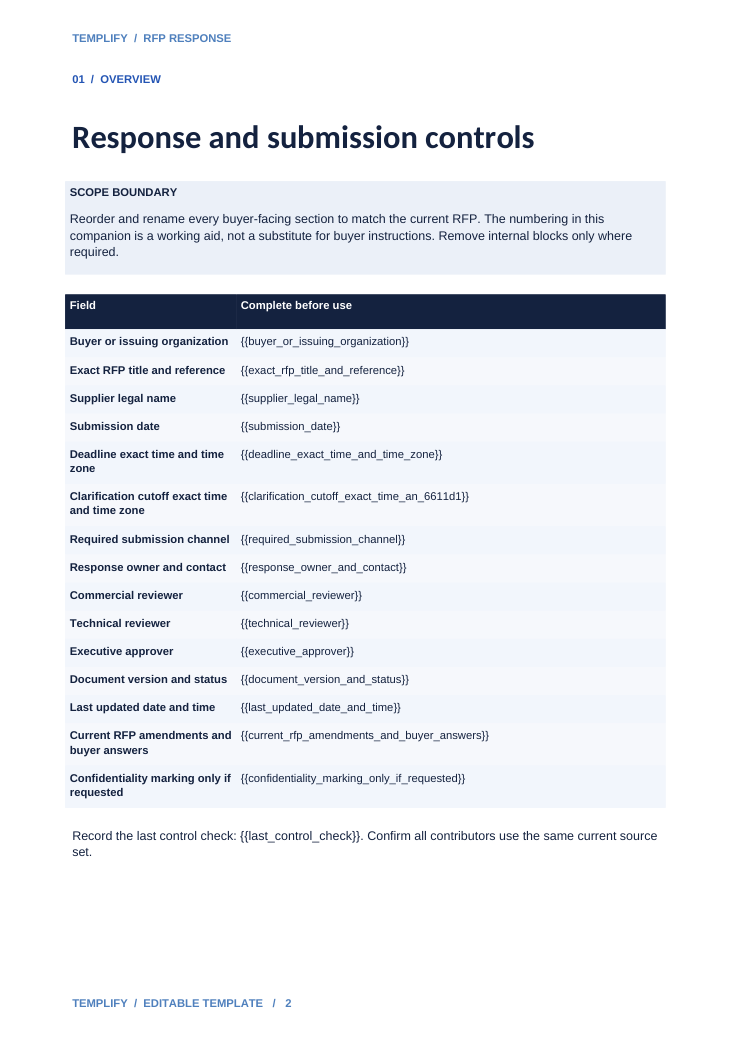
Preview the cover and an actual interior page, then make the proposal your own.
Edit in Word or upload to Google Docs.
Direct download. No email required.
What an RFP Response Template Must Contain
A supplier-side RFP response should follow the buyer’s instructions for structure, terminology, attachments, and delivery. A practical working template contains:
- A response document organized in the prescribed order
- A requirement-level RFP compliance matrix
- An executive response mapped to published evaluation criteria
- A proposed solution supported by verified evidence
- Relevant credentials and references
- A pricing schedule in the requested format
- Exceptions, deviations, and clarification registers
- A final submission check
This template doesn’t create the buyer’s RFP, scoring framework, or supplier-selection process. If the buyer hasn’t published a classification, criterion, or scoring weight, don’t guess it. Also check for amendments before drafting: a polished answer to an outdated requirement is still the wrong answer.
RFP Response Control Sheet
Use a control sheet to manage the working process, but repeat the essential submission controls inside the response document. This prevents deadline and version information from becoming separated from the file being reviewed.
| Control field | Entry |
|---|---|
| Buyer or issuing organization | [Name] |
| RFP title | [Exact title] |
| RFP reference number | [Reference] |
| Submission deadline | [Date, exact time, time zone] |
| Clarification cutoff | [Date, exact time, time zone] |
| Required submission channel | [Portal, email, or other method] |
| Response owner | [Name and contact details] |
| Commercial reviewer | [Name] |
| Technical reviewer | [Name] |
| Executive approver | [Name] |
| Version and status | [For example: v0.4, internal review] |
| Last updated | [Date and time] |
| Source materials | [RFP, amendments, buyer answers] |
| Confidentiality marking | [Only if requested] |
Record times with their time zones rather than relying on local settings. Add every buyer-issued amendment and formal clarification response to the source-material list, then confirm that contributors are using that version.
Copyable Google Docs RFP Response Shell
Keep the buyer’s numbering, terminology, page limits, and requested format. If the RFP calls its fourth section “4. Service Delivery,” don’t rename it “Our Approach.” Copy this shell into Google Docs and adapt it to the instructions:
COVER INFORMATION
Buyer:
RFP title and reference:
Supplier legal name:
Submission date:
Response owner and contact:
Document version:

SUBMISSION CONTROL — INTERNAL WORKING BLOCK
Deadline, exact time, and time zone:
Clarification cutoff, exact time, and time zone:
Required submission channel:
Current RFP and amendment version:
Response owner:
Last control check:
[Remove this block only if required before submission]

SIGNED FORMS OR DECLARATIONS
[Insert or attach only where required]

1. EXECUTIVE RESPONSE
Buyer outcomes:
Proposed approach:
Relevant, verified differences:
Evidence and cross-references:
Section owner:
Review status:

2. REQUIREMENT RESPONSES
[Repeat the buyer’s exact section and requirement sequence]
Requirement ID:
Response:
Evidence or attachment:
Assumptions or dependencies:
Owner:
Review status:

3. PROPOSED SOLUTION AND DELIVERY APPROACH
Scope:
Delivery model:
Milestones:
Governance:
Dependencies:

4. TEAM, CREDENTIALS, AND REFERENCES
Named personnel:
Verified qualifications:
Relevant references:
Evidence sources:

5. IMPLEMENTATION PLAN
Activities and milestones:
Buyer inputs:
Approvals and dependencies:

6. PRICING
[Complete the buyer’s required schedule]
Commercial assumptions:
Optional items:
Exclusions:

7. EXCEPTIONS AND DEVIATIONS
[Reference each affected requirement]

8. APPENDICES AND ATTACHMENTS
[Use the required names and order]
For reusable layouts outside the formal RFP package, review these agency proposal templates for Google Workspace. A general proposal layout can support presentation, but it shouldn’t override the required structure.
Google Sheets RFP Compliance Matrix Template
The matrix connects source instructions to answers, evidence, ownership, and review. Include one row per requirement, including requirements in appendices, pricing files, amendments, and submission instructions.
Paste this tab-separated block into cell A1 in Google Sheets:
Requirement ID	Source	Exact requirement	Buyer classification	Evaluation criterion	Response location	Compliance status	Evidence reference	Owner	Reviewer	Review state	Open action	Internal due date
SAMPLE ONLY — 3.2	SAMPLE ONLY — RFP p. 18, section 3.2	SAMPLE ONLY — Provide a named delivery lead and relevant experience	SAMPLE ONLY — Mandatory	SAMPLE ONLY — Delivery capability	SAMPLE ONLY — Section 4.1	Partial	SAMPLE ONLY — CV-01 pending approval	Delivery lead	Bid reviewer	Review	Approve CV-01	[Date]
SAMPLE ONLY — P-1	SAMPLE ONLY — Pricing workbook, row 12	SAMPLE ONLY — Provide a monthly unit price for 12 months	SAMPLE ONLY — Not stated	SAMPLE ONLY — Not stated	SAMPLE ONLY — Pricing workbook, row 12	Compliant	SAMPLE ONLY — Pricing calculation PR-04	Commercial lead	Finance reviewer	Approved	None	[Date]
SAMPLE ONLY — S-4	SAMPLE ONLY — Submission instructions p. 4	SAMPLE ONLY — Upload signed response as one PDF through the procurement portal	SAMPLE ONLY — Mandatory	SAMPLE ONLY — Not stated	SAMPLE ONLY — Final submission package	Not applicable	SAMPLE ONLY — Submission receipt after upload	Response owner	Independent reviewer	Drafting	Obtain signature	[Date]
These are illustrative sample rows, not buyer-supplied requirements. Delete them before entering the actual RFP requirements.
Apply Google Sheets data validation to the Compliance status column with these values: Compliant, Partial, Exception, and Not applicable. Apply validation to Review state with: Not started, Drafting, Review, and Approved. These labels are internal tracking labels unless the buyer defines a required response scheme. If it does, use the buyer’s terminology in the submitted response and, if useful, map it to internal labels in a separate column.
A status such as Partial should trigger a decision, not conceal uncertainty. The team may need additional evidence, a documented exception, a clarification question, or a revised answer.
Worked requirement flow
Suppose the current RFP states, “Provide a named delivery lead with five years of relevant experience.” The matrix preserves that wording and cites section 3.2 of the amended RFP. The drafted response names the proposed lead and briefly explains relevant experience. CV-01 is entered as the evidence reference.
During verification, the reviewer confirms only four years of directly comparable experience. The matrix status changes from Compliant to Partial, and the exception log records the precise gap and proposed alternative: oversight from a more experienced programme director. The response is revised so it doesn’t overstate the lead’s record. After commercial and delivery approval, the review state becomes Approved, while the buyer-facing response uses whatever compliance terminology the RFP requires.
Map the Executive Response to Evaluation Criteria
The executive response should explain how the proposal fits the buyer’s stated outcomes, rather than opening with several paragraphs of general company history. Restate the desired outcomes in the RFP’s terminology, connect them to published evaluation criteria where available, summarize the approach, and cross-reference detailed evidence.
Separate confirmed facts, assumptions, and proposed commitments. If the buyer evaluates implementation planning, summarize the proposed phases and point to the implementation section. Don’t call it the highest-weighted criterion unless the buyer says so.
Verify Evidence, Credentials, and References
Every capability claim should have an identifiable source and owner. Check named personnel, qualifications, certifications, dates, project details, and reference contacts before including them.
Choose examples comparable in scope, sector, complexity, or intended outcome, and obtain any necessary permission before naming a client or contact. When evidence is unavailable, record an open action or exception instead of adding unsupported language.
An evidence register can capture the supported requirement, evidence description, source, owner, verification date, permission status, and final attachment name. For delivery planning, this statement of work template for Google Docs can help organize scope, responsibilities, and deliverables. It doesn’t replace the RFP response or a buyer-required form.
Reconcile the RFP Pricing Schedule
Complete the buyer’s requested pricing workbook or schedule instead of replacing it with a custom quotation. Preserve the specified currency, units, periods, quantities, categories, and tax treatment.
Recalculate unit prices, subtotals, taxes, and totals, then compare them across the pricing file and narrative. Separate required pricing from optional items, disclose assumptions and exclusions, and confirm that the priced scope matches the proposed solution.
If the buyer requests a monthly unit price for 12 months, don’t provide only an annual lump sum. Show the requested monthly unit, quantity, subtotal, applicable tax treatment, and total. Route unclear or conflicting instructions through the clarification process rather than silently choosing an interpretation.
Log Exceptions, Dependencies, and Clarifications
Maintain connected but distinct registers. The exception log records departures from requirements, including the affected clause, precise gap, alternative, effect on scope, timing, or price, owner, and resolution. The clarification log records questions submitted to the buyer, responses received, affected requirements, and resulting changes.
Dependencies should identify buyer inputs, access, approvals, or third-party actions needed for delivery. State them explicitly instead of presenting conditional work as unconditional compliance. When an amendment changes a requirement, update the matrix, draft, evidence references, and review state together; changing only the narrative creates avoidable inconsistencies.
RFP Submission Checklist
Before release, conduct an independent review against the current source instructions. Confirm the deadline and time zone, required channel, file names, formats, signatures, attachment inventory, limits, and pricing totals. Remove comments, tracked changes, and placeholders. Verify that every mandatory requirement is answered or explicitly excepted, and test final cross-references after pagination.
Submit through the mandated channel, retain the confirmation, and preserve an exact copy of the submitted package. Don’t substitute a proposal link for a required portal upload, file package, or submission email.
Optional Google Workspace Proposal Workflow
Keep any presentation workflow separate from the formal submission. Once the required files are complete, Templify can use existing Google Docs, Slides, and Sheets as proposal sources, publish client-ready proposal links, track views and engagement, and support reusable agency proposal workflows. You can also create proposals from Google Sheets.
The buyer-required files remain authoritative. A proposal link cannot replace the mandated channel, and view signals aren’t evidence that the buyer received a formal RFP submission.
Frequently Asked Questions
What is the difference between an RFP response template and a general proposal template?
An RFP response template follows the buyer’s prescribed order, numbering, pricing format, evidence requests, and submission rules. A general proposal usually follows the supplier’s preferred sales narrative and may not provide requirement-level control.
What columns should an RFP compliance matrix include?
Include the requirement ID, source, exact wording, buyer-supplied classification, stated evaluation criterion, response location, internal compliance status, evidence, owner, reviewer, review state, open action, and due date.
How should a supplier respond when it only partially meets a requirement?
Describe the gap precisely, record supporting evidence and dependencies, and explain any proposed alternative and its effect. Use the buyer’s required response scheme if one exists; otherwise, an internal Partial label can keep the issue visible until resolved or approved as an exception.
Can a proposal link replace required RFP files or portal submission?
No. Use the buyer’s mandated portal, email address, file format, or other formal channel. A proposal link can support a separate presentation workflow only when it doesn’t replace required submission materials.
How do you check an RFP pricing schedule before submission?
Recalculate units, quantities, subtotals, taxes, and totals; compare figures across files; separate required and optional items; review assumptions and exclusions; and confirm that the priced scope matches the proposed solution.
Editable Word template · free download
Download the rfp response template
Preview the cover and an actual interior page, then make the proposal your own.
Edit in Word or upload to Google Docs.
Direct download. No email required.